

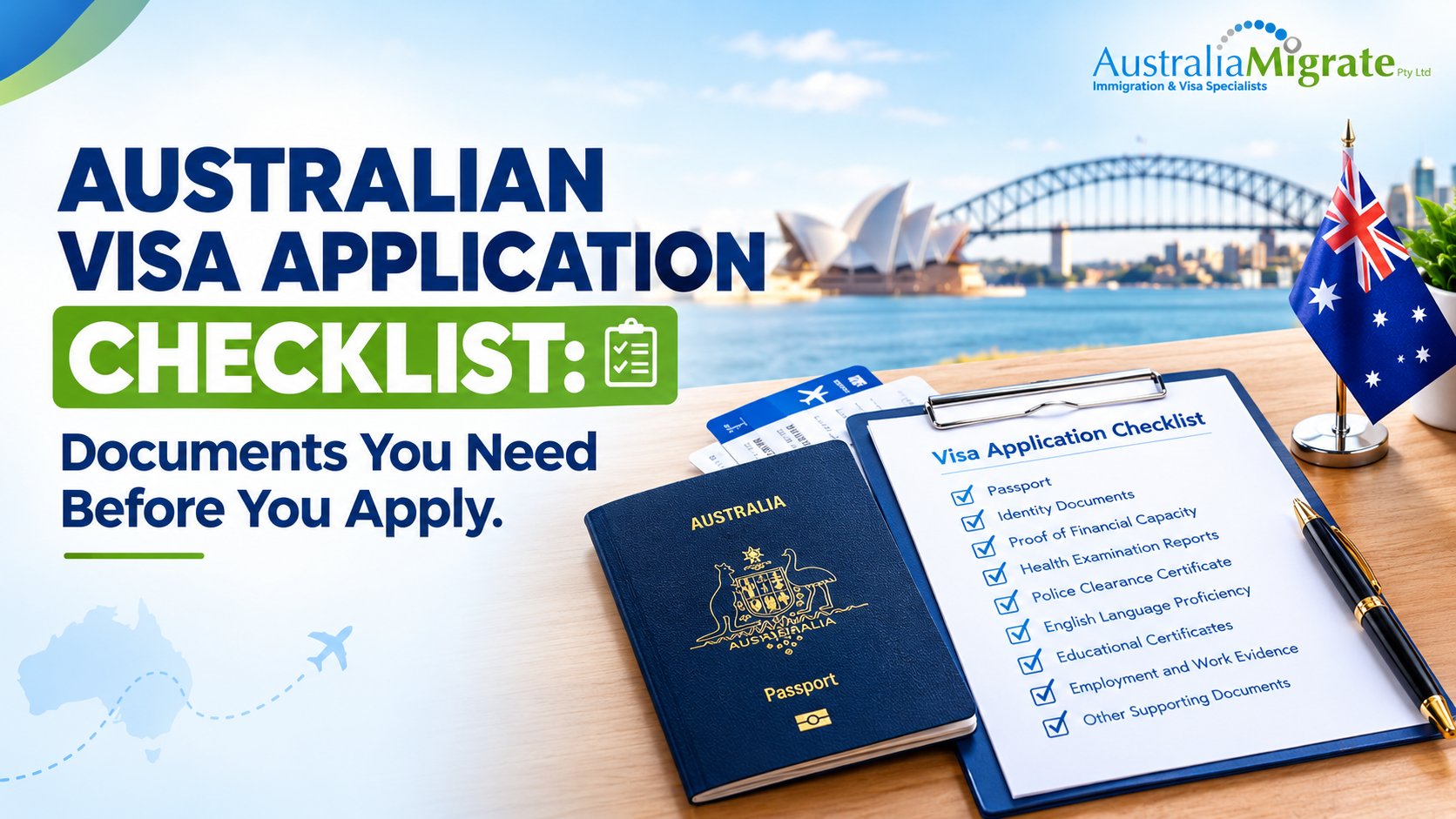
Getting your Australian visa application right the first time comes down to one thing more than any other: having the right documents ready before you start. Missing or incomplete evidence is one of the most common reasons applications get delayed or are asked for more information. This checklist covers the document categories that come up across most visa types, so you can start gathering what you need before you even open the application form.
Page Contents
ToggleThis is general information, not personalised migration advice. Only a Registered Migration Agent or Australian legal practitioner can lawfully advise on your specific situation. Book a consultation with our team if you’d like tailored guidance.
1. Identity Documents
Every Australian visa application starts with proof of who you are. At a minimum, you’ll typically need:
- A valid passport with enough validity to cover your intended stay
- A certified copy of your birth certificate, where available
- A national identity card or driver’s licence, if you have one
- Passport-style photos meeting the Department’s specifications
The Department of Home Affairs confirms that identity evidence generally includes a copy of your passport along with a certified copy of your birth certificate, national identity card or driver’s licence where these exist.[1]
2. Proof of Financial Capacity
Many visa categories require evidence that you can support yourself (and any family members included in your application) while in Australia. This commonly includes:
- Bank statements showing consistent balances
- Payslips or an employer statement of income
- Evidence of assets or savings
- For some visas, a sponsor’s or family member’s proof of income if they’re supporting you financially
Exact fund requirements differ by visa subclass, so check the specific figures for your visa type before assuming a general number applies.
3. Health Examination Evidence
Most visa applicants need to meet health requirements, which can involve a medical examination through an approved panel physician, particularly for longer-stay visas. Health examination results are generally valid for around 12 months, so timing your medical relative to your application matters, especially if processing is likely to take a while.
4. Character Documents (Police Clearance Certificates)
Everyone applying for an Australian Visa Application is assessed against the character requirement under the Migration Act 1958. If you’re 16 or older and have lived in a country for 12 months or more (accumulated over the last 10 years), you’ll generally need to provide a police clearance certificate from that country covering the relevant period. Depending on your history, you may also be asked for additional character documents, such as a statutory declaration or Form 80.
5. English Language Evidence
If your visa category requires proof of English proficiency, you’ll typically need results from an approved English language test. Some applicants are exempt, for example, citizens of certain countries, or those who’ve completed a set number of years of English-medium study, so check the specific exemption categories for your Australian Visa Application before booking a test you may not need.[1]
6. Relationship and Family Documents
If you’re including a partner, spouse or dependants in your application, you’ll usually need:
- A certified copy of your marriage certificate, or evidence of a de facto relationship
- Evidence of any name changes (marriage certificate, deed poll, or similar)
- Birth certificates for dependent children
- A signed consent form if a child under 18 is included and one parent isn’t part of the application
7. Employment and Qualification Evidence
For skilled and employer-sponsored visas, you’ll generally need to show your work history and qualifications, which can include:
- Certified copies of academic transcripts and qualification certificates
- Payslips or an employment contract
- An up-to-date CV or résumé covering your recent employment and study history
- A skills assessment from the relevant assessing authority, for many skilled visa categories
8. Migration Agent Paperwork (If You’re Using One)
If a registered migration agent or exempt person is helping with your application, they’ll typically lodge a signed Form 956 to formally notify the Department of their involvement. If you’re deciding whether to use an agent at all, it’s worth reading through how to choose a registered migration agent before you commit to one.
Document Checklist by Visa Category (General Overview)
This is a general guide only. Always confirm the exact requirements for your specific visa subclass.
| Document Category | Skilled Visas | Employer-Sponsored Visas | Partner Visas | Student Visas |
|---|---|---|---|---|
| Identity documents | Required | Required | Required | Required |
| Proof of funds | Sometimes | Rarely | Sometimes | Required |
| Health examination | Usually required | Usually required | Usually required | Usually required |
| Character/police clearance | Usually required | Usually required | Usually required | Usually required |
| English language evidence | Usually required | Sometimes | Sometimes | Often required (or exempt) |
| Relationship documents | Not applicable | Not applicable | Required | Not applicable |
| Employment/qualification evidence | Required | Required | Not applicable | Sometimes (proof of employment) |
| Skills assessment | Usually required | Sometimes | Not applicable | Not applicable |
Step-By-Step: How to Prepare Your Visa Application Documents
Step 1: Identify your exact visa subclass. Requirements vary significantly even between visas that sound similar.
Step 2: Use the Department’s Document Checklist Tool. It generates a tailored list based on your circumstances.[1]
Step 3: Gather originals and arrange certified copies. Many documents need to be certified copies, not just scans of originals.
Step 4: Book your health examination early. Results are generally valid for around 12 months, so timing matters if your case is likely to take a while.
Step 5: Apply for police clearance certificates from every relevant country. These can take weeks or months to arrive from some countries, so start early.
Step 6: Arrange translations for non-English documents. Documents not in English generally need to be accompanied by an accredited translation.
Step 7: Review everything before lodging. A second look often catches missing signatures, expired documents or inconsistent details across your application.
Common Mistakes That Delay Visa Applications
- Submitting low-quality or cropped scans. Blurry or partial documents often trigger requests for more information.
- Letting a police certificate or medical result expire before lodging. Both have limited validity, generally around 12 months.
- Inconsistent information across documents. Names, dates and details should match exactly across your passport, certificates and forms.
- Missing a country in your police clearance history. Any country you lived in for 12+ months in the last 10 years generally needs its own certificate.
- Assuming your English test is required when you might be exempt. Check exemption categories before booking a test.
Contact our team if you’d like a document checklist tailored to your specific visa subclass.
Frequently Asked Questions
- What’s the most important document for any Australian visa application? A valid passport is the starting point for every application, alongside proof of identity such as a birth certificate where available.[1]
- How long is a police clearance certificate valid for an Australian visa? Police clearance certificates are generally valid for around 12 months from the date of issue.
- Do I need a medical exam for every Australian visa? Most visa categories, particularly longer-stay visas, require a health examination through an approved panel physician, though requirements vary by visa subclass.
- Is an English language test always required? No. Several exemption categories exist, including citizens of certain countries and applicants who’ve completed set periods of English-medium study.[1]
- Do documents need to be translated if they’re not in English? Generally, yes, documents not in English need to be accompanied by an accredited translation.
- How do I know exactly which documents I need for my specific visa? The Department of Home Affairs provides a Document Checklist Tool that generates a tailored list based on your circumstances and visa type.[1]
- Do I need a migration agent to help prepare my documents? It’s not a legal requirement for most applications, but a registered migration agent can help you avoid missing evidence, particularly for complex cases. See our guide on choosing a registered migration agent.
- What happens if I submit an incomplete application? Missing documents commonly lead to delays while the Department requests additional information, which can add significant time to your processing.
Get Help Preparing Your Visa Application
Gathering the right documents upfront is the single biggest factor in avoiding delays on your Australian visa application. Our registered migration agents can give you a tailored checklist for your specific visa subclass and review your evidence before you lodge.