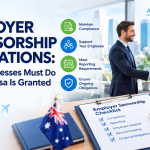


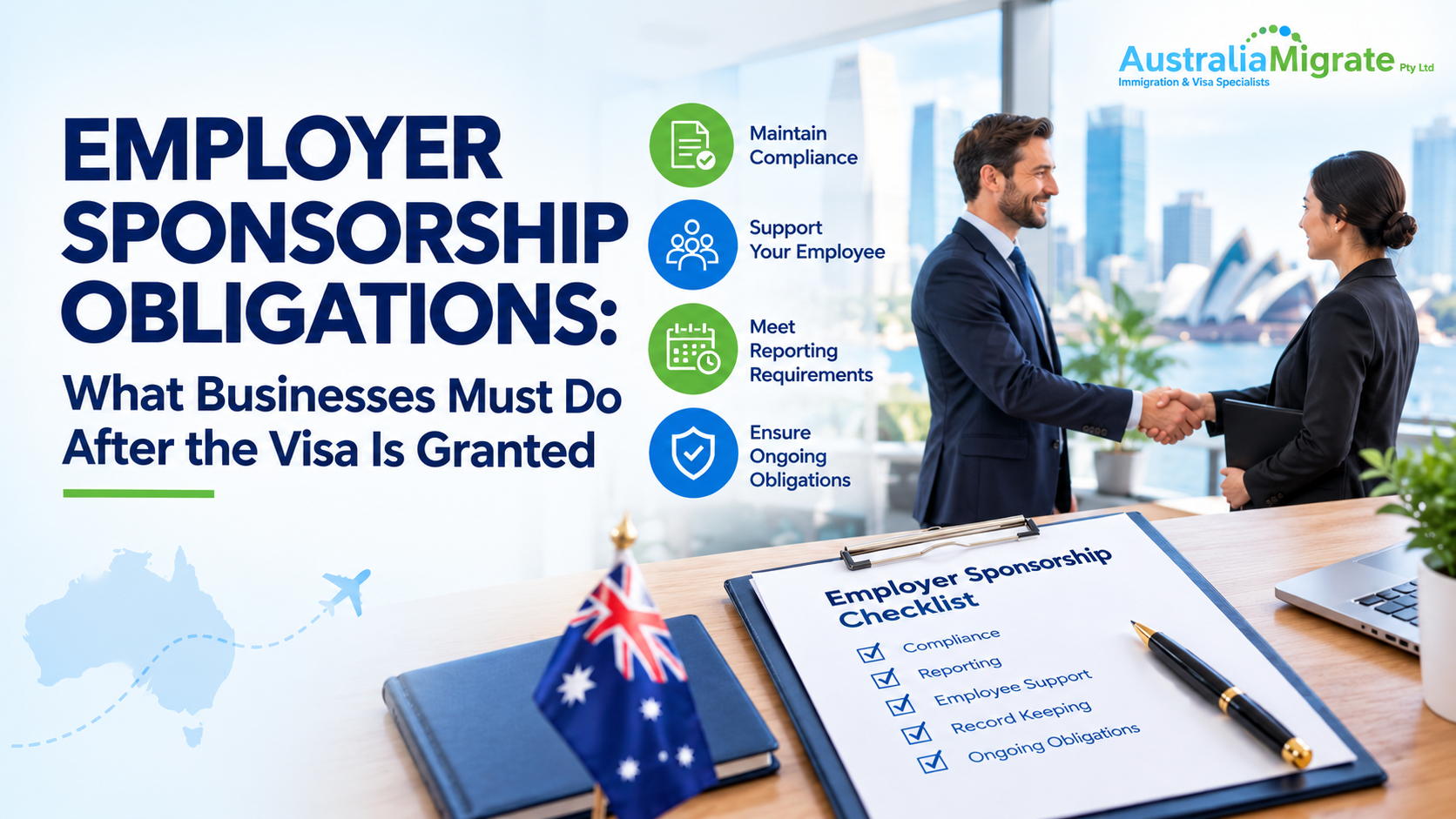
Getting the visa granted feels like the finish line. For employer visa sponsorship, it’s actually the starting line. Once your sponsored employee’s visa is approved, a set of ongoing legal obligations kicks in, and they don’t end when the visa is issued. They run for as long as you employ the sponsored worker, and in some cases, for years after.
This guide covers what businesses need to do once an employer visa sponsorship has been granted, so you can stay compliant and avoid the kind of breach that lands a business on a public sanctions register.
This is general information, not compliance advice for your specific business. Speak with a registered migration agent about your obligations. Book a consultation for tailored guidance.
Why Sponsorship Obligations Exist
Sponsorship obligations aren’t paperwork for its own sake. They exist to make sure overseas workers are protected from exploitation and that the Employer visa sponsorship programs are used for genuine skills shortages, not to undercut local wages and conditions.[1] The Department of Home Affairs and the Australian Border Force actively monitor sponsor compliance, and breaches carry real consequences, up to fines which can be significant and including being named on a public register.
1. The 28-Day Notification Rule
As a sponsor, you must tell the Department within 28 days of certain events occurring, including:
- Your sponsored employee stops working for you, has a change in duties, or never started work
- Your business becomes insolvent, goes into receivership, liquidation or administration, or ceases to exist as a legal entity[1]
Notifications are generally made through the ‘Notification of sponsor changes’ form in ImmiAccount, or by email for labour agreement holders and paper-based applications.[1] Missing this window, even unintentionally, is treated as a compliance failure.
2. Ongoing Training Obligations (SAF Levy)
Standard business sponsors pay the Skilling Australians Fund (SAF) levy as a mandatory training contribution when nominating a worker under the relevant Employer visa sponsorship programs. It’s paid upfront at nomination, covers the full period of the nominated stay, and it isn’t refundable if the visa is later refused but could be partially refundable if the worker leaves early for any full year not worked. Critically, employers cannot pass this cost on to the sponsored worker, directly or indirectly. This obligation is separate from, and in addition to, the notification duties above.
3. Equal Pay and Employment Conditions
Sponsored employees must be treated on the same terms as an equivalent local Australian worker, including pay, entitlements and working conditions. This is one of the core obligations regulators check when reviewing a sponsor’s compliance history.
4. Record-Keeping
Sponsors are expected to keep records that demonstrate ongoing compliance, including records of the employee’s role, salary, working conditions, and any changes reported to the Department. These records can be requested during an audit or investigation, so treating record-keeping as a one-off task rather than an ongoing habit is a common mistake.
5. Keeping the Role Genuine
The sponsored employee generally needs to keep working in the occupation their visa was approved for. If their role changes significantly, this usually needs to go through the Department before the change takes effect, not after. Additionally, they cannot do after hours work in another part of the business tunelated to the occupation they were nominated for.
6. Cooperating with Inspections
Immigration Inspectors and Fair Work Inspectors have investigative powers to check sponsor compliance. This can include site visits, document requests, and information-sharing between agencies. Sponsors are expected to cooperate fully, and refusing or obstructing an inspection is treated as its own compliance issue.
What Happens If You Breach Sponsorship Obligations
The Department of Home Affairs and Australian Border Force take a structured approach to non-compliance:
- Administrative sanctions: Current sponsorship approvals can be cancelled, and businesses can be barred from sponsoring workers in future
- Civil penalties: Courts can impose civil penalty orders against businesses and individuals for serious breaches
- Public sanctions register: The Australian Border Force maintains a publicly available register of sponsors who have breached their obligations, dating back to 18 March 2015, specifically to deter other sponsors and help protect foreign workers who might otherwise consider working for a sanctioned employer[2]
Being named on that register is a reputational risk that outlasts the financial penalty itself.
Sponsor Obligations Timeline: Standard Business Sponsors
| Visa Program | Typical Sponsorship Period | Standard Business Sponsorship Approval Length |
|---|---|---|
| Skills in Demand (subclass 482) — replaced the Temporary Skill Shortage (482) visa on 7 December 2024[2] | 1 to 5 years, depending on stream and circumstances[2] | 5 years |
| Skilled Employer Sponsored Regional (subclass 494)[2] | 1 to 5 years, depending on stream and circumstances[2] | 5 years |
Obligations generally continue for the duration of the sponsorship period, and monitoring can extend for a period after the sponsorship ends.
Step-By-Step: What To Do After the Visa Is Granted
Step 1: Diarise your notification obligations. Set internal reminders so HR knows the 28-day clock starts the moment a trigger event happens, not when someone gets around to reporting it.
Step 2: Confirm the SAF levy was paid correctly at nomination. Check this was recorded and wasn’t passed on to the employee in any form.
Step 3: Document the employee’s role, pay and conditions. Keep this aligned with what was approved in the nomination.
Step 4: Build a record-keeping system. Store employment contracts, payslips, and any Department correspondence in one place, ready for an audit.
Step 5: Review role changes before they happen. If duties are shifting significantly, check with a migration agent before the change takes effect.
Step 6: Prepare for possible inspections. Make sure relevant staff know what to do if an Immigration or Fair Work Inspector makes contact.
See our related guide on employer-sponsored visa mistakes for a closer look at the errors that most often trigger compliance issues.
Common Mistakes Businesses Make Post-Grant
- Treating the visa grant as the end of the process. Obligations start, not stop, at grant.
- Missing the 28-day notification window. This is the single most common compliance failure.
- Letting HR and payroll work in silos. Pay and role changes need to flow through to whoever tracks sponsorship compliance.
- Assuming informal role changes don’t count. Even a gradual shift in duties can take an employee outside their approved occupation.
- Not keeping records until an audit happens. By then, it’s often too late to reconstruct a clean compliance history.
Frequently Asked Questions
- How long do employer sponsorship obligations last? Obligations generally apply for the duration of the sponsorship, and monitoring can continue for a period after the sponsorship period ends.[1]
- What triggers the 28-day notification requirement? Events such as your sponsored employee ceasing employment, changing duties, or not starting work, or your business becoming insolvent or ceasing to exist as a legal entity.[1]
- Can I pass the SAF levy cost on to my sponsored employee? No. Employers cannot recover the SAF levy from the sponsored worker, directly or indirectly.
- What happens if I miss a notification deadline? It can be treated as a compliance breach and can factor into sanctions, even if the missed notification was unintentional.
- Do sponsorship obligations apply to both the 482 and 494 visa programs? Yes, standard business sponsors have obligations that apply across the Skills in Demand (482) and Skilled Employer visa sponsorship Regional (494) programs.[2]
- What’s the public sanctions register, and can my business end up on it? The Australian Border Force keeps a public register of sponsors who’ve breached their obligations, dating back to 18 March 2015. Serious or repeated breaches can result in a business being listed.[2]
- Do I need a migration agent to manage ongoing sponsorship compliance? It’s not a legal requirement, but many businesses use one to track notification deadlines and record-keeping, especially if they sponsor multiple employees. See our guide on choosing a registered migration agent.
- Where do I report a suspected breach by another sponsor? Suspected breaches can be reported anonymously to the Australian Border Force’s Border Watch.[2]
Stay Compliant on Your Employer Visa Sponsorship
Sponsorship obligations don’t stop when the Employer visa sponsorship is granted, and treating them as an afterthought is one of the most common (and costly) mistakes businesses make. Our registered migration agents help employers set up compliance systems that hold up under scrutiny, from notification tracking to record-keeping.